Cart
0
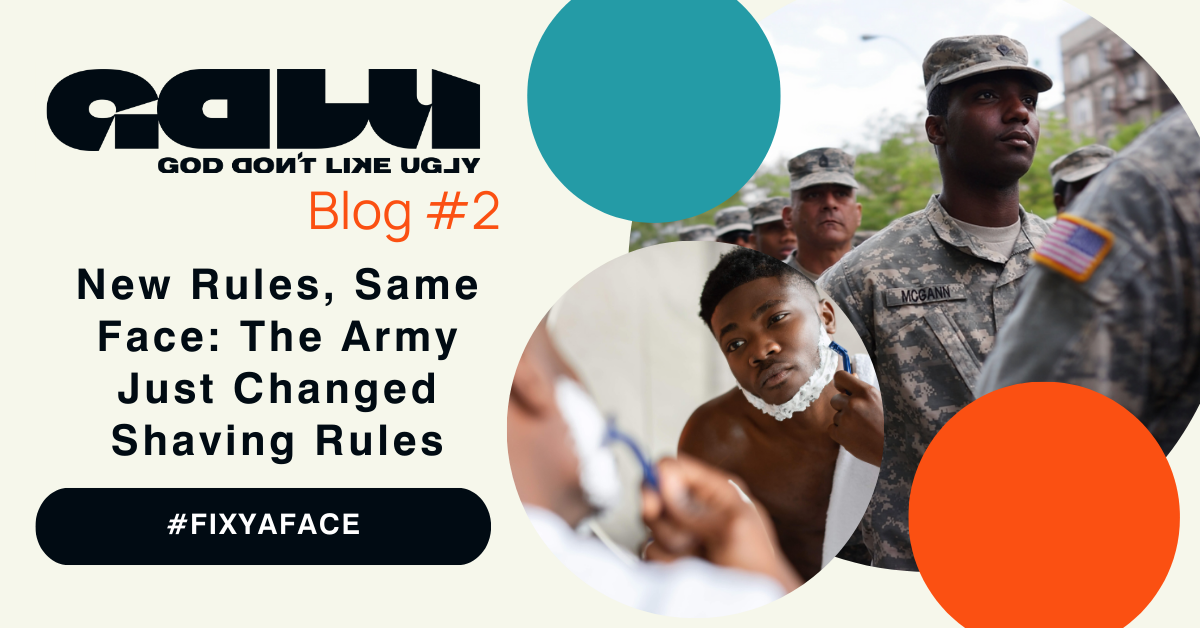
New Rules, Same Face: The Army Just Changed Shaving Rules
In July 2025, the Army dropped Army Directive 2025‑13, a force‑wide update to facial hair grooming standards.[1] On the surface, the directive doesn’t sound new: soldiers must be clean‑shaven when in uniform or on duty in civilian clothes. That has technically been the rule for decades.[2]
Where it does change the game is how the Army handles shaving waivers—especially for pseudofolliculitis barbae, the painful razor bump condition that mostly affects men with tightly curled hair.[4] Under the new directive:
-
Permanent medical shaving waivers are gone.
-
Soldiers with PFB can only receive temporary medical profiles, backed by an exception‑to‑policy memo from a senior commander.[1][2]
-
Those exemptions must be tied to a treatment plan that healthcare providers monitor over time.[2]
-
If a soldier cannot get their condition under control and meet grooming standards in a “reasonable” timeframe, they can face administrative separation.[1]
The official message is discipline and readiness. A clean shave helps ensure gas masks and other protective gear seal properly, which matters in combat or chemical environments.[5] The uniform look is also framed as part of the Army’s professional image.[2]
For many Black soldiers and other men of color, though, the policy hits on a different level: not just how they look in formation, but how their skin feels 24/7.
Pseudofolliculitis Barbae: When Your Hair Fights Back

“Pseudofolliculitis barbae” sounds like a retired Roman general, but the breakdown is simple:
-
“Pseudo” = false
-
“Folliculitis” = inflammation of the hair follicle
-
“Barbae” = of the beard
What it really describes is this: after shaving, curly hair is cut so close that the sharp tip curls back into the skin instead of growing straight out.[4] That hair, trapped under the surface, triggers the body’s defense system and creates:
-
Painful, swollen razor bumps
-
Ingrown hairs that feel like tiny needles under the skin
-
Itchiness and burning along the jawline and neck
-
Dark marks, hyperpigmentation, and uneven tone from constant irritation
Because tighter curl patterns are more common in people of African descent, PFB disproportionately affects Black men.[4] It is not about “sensitive” personality—it is about how the hair grows and how the skin responds. When a policy demands daily or near‑daily shaving, that biology turns grooming into a constant battle.
GDLU was built for that exact kind of battle: where hair, skin, and expectations collide, and ignoring it stops being an option.[3]
Why These Grooming Standards Feel So Heavy for Men of Color
[IMAGE: Split image with a soldier in dress uniform on one side and a close‑up of mild razor bumps on the neck on the other.]
On paper, the directive looks neutral: one rule for everyone, limited exceptions, strong chain‑of‑command oversight.[1][2] On the ground, the impact is not evenly distributed. If your hair is naturally straight and shaving leaves you with smooth skin and maybe a little dryness, this is just another regulation to follow.
If you have tightly curled or coarse hair, daily shaving can mean:
-
Burning neck and jawline by mid‑morning
-
Visible red or dark bumps that no amount of aftershave can hide
-
Bleeding or torn skin if you rush the process to make formation
-
Feeling like you have to choose between comfort and compliance
Supporters of the policy emphasize discipline, cohesion, and tradition, arguing that consistent standards reinforce professionalism and readiness.[2][6] Critics—especially within communities most affected by PFB—question whether removing permanent waivers truly accounts for the biological reality of textured hair and melanin‑rich skin.[4][7]
GDLU’s stance is simple: the rules are bigger than one brand, but the impact is deeply personal. Skin is not a side issue. For many soldiers, especially Black and brown men, it’s another front line they have to manage while they serve.[3]
Shaving Under Pressure: Technique as Self‑Defense

You cannot rewrite Army regulations from your bathroom sink. What you can control is how you shave and how you treat your skin before and after. Technique and skincare will not erase PFB entirely, but they can reduce how often hair bumps and ingrown hairs show up—and how bad they get.
A soldier‑ready shaving approach looks like this:
1. Prep the face, don’t attack it.
Start with a lukewarm shower or a warm, damp towel pressed against your beard area. This softens both hair and skin and helps prevent the blade from dragging.[3][8]
2. Use a gentle cleanser.
Wash your face with a mild, non‑stripping cleanser. This removes sweat, oil, and product build‑up from helmets, collars, and masks that can clog follicles and make irritation worse.[8]
3. Shave with the grain.
For curly hair, shaving against the grain might give that baby‑smooth feel—until the hair curls back under the skin and turns into a razor bump. Shave in the direction your hair grows, using short, controlled strokes and minimal pressure.
4. Be intentional with your tools.
Multi‑blade razors can lift and cut hairs below the skin’s surface, which is risky for men prone to PFB.[4] Many dermatologists recommend single‑blade, guarded, or electric options for textured hair, even if that means a slightly less close shave.
5. Rinse cool and calm the skin.
Rinse with cool water to help close pores and calm inflammation, then pat (don’t rub) your face dry with a clean towel. This is the moment your skin is most vulnerable—which is where GDLU comes in.
Done consistently, this kind of routine turns shaving from a daily ambush into a managed mission.
Where GDLU’s Premium Gel Cream Fits In

GDLU exists because men of color were tired of products that treated their skin like an afterthought.[3] The brand brings barbershop honesty to skincare—no magic tricks, no over‑promises, just formulas designed for melanin‑rich, often razor‑sensitive skin.
The Premium Gel Cream is built to slide straight into a soldier’s morning and night routine without slowing anything down:
-
Lightweight hydration: The gel‑cream format sinks in quickly and doesn’t leave a greasy film. That matters when you’re putting on a uniform, gear, or body armor and can’t afford a slippery face.[8]
-
Barrier support: Daily shaving can strip the skin’s natural defenses. Hydrating humectants and emollients help rebuild that barrier so the skin is less reactive to friction from collars, straps, and chin straps.
-
Soothing action: Botanically inspired ingredients like aloe‑style complexes or licorice‑like extracts can be described as calming and cooling, which is crucial right after the razor has passed over already‑irritable areas.[8]
-
Tone‑friendly care: For men who develop dark spots after every flare‑up, consistent moisture and reduced irritation are base camp. You cannot even the tone if you keep wounding the same areas every morning.
Used after every shave—and again at night on clean skin—the cream becomes more than a moisturizer. It becomes part of the strategy to keep razor bumps, ingrown hairs, and irritation from running your life.
A Daily Routine Blueprint for Soldiers With Hair Bumps

For soldiers living under the new policy, a realistic, no‑fluff daily routine might look like this.
Morning (Before Duty)
-
Cleanse
-
Rinse your face with lukewarm water.
-
Massage a gentle cleanser into the beard area for 30–60 seconds.
-
Rinse thoroughly; no residue left behind.
-
Shave (If Required That Day)
-
Use a warm towel or shower first to soften hair.
-
Apply your shaving product of choice—foam, cream, gel—avoiding harsh alcohol‑heavy formulas that burn.
-
Shave with the grain using short strokes, rinsing the blade frequently.
-
Avoid stretching the skin tight; that can cause hairs to retract below the surface.
-
Cool and Hydrate
-
Splash with cool water to calm the area.
-
Pat dry with a clean towel.
-
Smooth a thin layer of GDLU Premium Gel Cream over the entire beard area and neck, letting it absorb fully before putting on your uniform.
Night (After Duty)
-
Cleanse again to remove sweat, dust, and product build‑up from the day.
-
Apply another layer of Gel Cream to support overnight repair and keep the skin supple for the next morning’s shave.
It is not a spa ritual. It is a quick, disciplined system that respects your time and your face at the same time.
Understanding Profiles, Treatment Plans, and Your Role

Under Army Directive 2025‑13, the days of a “set it and forget it” permanent shaving profile are over.[1] Now, if you have PFB or another shaving‑related condition, your exemption comes with strings attached—and some of those strings can work in your favor if you treat them as a partnership instead of punishment.
The directive outlines that:
-
Healthcare providers must diagnose the condition and document it properly.
-
Providers are expected to build a treatment plan—this can include medication, specific shaving recommendations, and follow‑up visits.[2]
-
Commanders at the O‑5 level must approve exceptions, staying engaged instead of just signing once and moving on.[1]
-
Soldiers must keep proof of their profile and exemption on them in uniform or on duty in civilian clothes, ready to show if asked.[2]
What this means for you:
-
Show up informed. Go to medical with clear notes: how often you shave, what tools you use, where the bumps occur, and how long they last.
-
Ask system‑level questions. “What razors or techniques do you recommend for PFB?” “How often should I be shaving under this plan?”
-
Connect skincare and treatment. If a doctor prescribes medication or a special wash, think about how GDLU’s Gel Cream fits in as the hydrating, soothing step—not a replacement, but a support.
Being proactive shows your chain of command that you are not trying to dodge standards; you are trying to meet them without destroying your skin in the process.
The Mental Load: Skin, Identity, and Serving With Pride
[IMAGE: Two men of color—one in uniform, one in civilian clothes—talking outside a barbershop.]
People often talk about razor bumps as if they are just cosmetic. Anyone who has lived with them knows better. When you are constantly dealing with painful hair bumps, ingrown hairs, and visible dark marks, it does something to how you move through the world.
For men of color in uniform, that weight is multiplied:
-
You are told to be clean‑shaven, even when your body keeps telling you it doesn’t respond well to that.
-
You worry about being judged as “unprofessional” for the bumps caused by following the rules.
-
You may feel like your genetics were never in the room when grooming standards were created.
GDLU talks about constructive confidence—the kind that comes from showing up as your best self, not pretending you never struggle.[3] In that frame, taking care of your skin becomes an act of respect, not vanity. You are not trying to look “pretty”; you are trying to keep the face you were given in good working order while you serve a demanding institution.
Why GDLU Shows Up for Soldiers

GDLU was built for men of color who are carrying a lot—families, careers, community expectations, and now, for many, the weight of a stricter grooming policy with real consequences.[3] The brand’s role is not to lobby or write directives. The role is to stand beside the men who live inside those regulations and say:
-
Your skin matters.
-
Your comfort matters.
-
Your confidence matters.
By blending barbershop culture with high‑quality, science‑driven skincare, GDLU gives soldiers something they rarely get in this space: a product line that speaks their language and understands their biology.[3][8] It is a reminder that self‑care and masculinity are not opposites—and that God Don’t Like Ugly applies to how we treat ourselves, not just how we talk to others.
#FixYaFace, Keep Your Career, Protect Your Peace

The Army’s new shaving rules are here, and they are not going away anytime soon.[1][2] For men of color, they raise hard questions about fairness, biology, and what it means to show up in a system that was not always designed with your skin in mind.[4]
GDLU cannot rewrite the directive, but it can help you fight a smarter fight. By combining better shaving habits, disciplined skincare, and products built for melanin‑rich, razor‑sensitive skin, you can protect both your face and your future in uniform.
So to every soldier navigating these grooming standards: stay sharp, stay informed, and take your skin seriously. You have put in too much work to let hair bumps and ingrown hairs write your story for you. Build your routine, share what works with your brothers, and remember—on and off duty—your job is not just to show up.
Your job is to show up looking and feeling like the man you were meant to be. That is what it means to #FixYaFace.
Skincare Blog References:
Sources [1] [PDF] Army Directive 2025-13 (Facial Hair Grooming Standards) https://lyster.tricare.mil/Portals/61/ARN44307-ARMY_DIR_2025-13-000.pdf [2] Army updates facial hair policy to reinforce grooming standards https://www.usar.army.mil/News/News-Display/Article/4237272/army-updates-facial-hair-policy-to-reinforce-grooming-standards/ [3] 12302024_GDLU_brandbook.pdf https://ppl-ai-file-upload.s3.amazonaws.com/web/direct-files/collection_a3a6dff1-531a-4609-81bb-a8a75a8bba53/7f7063dd-3852-4b08-89f4-30bd3526ef3f/12302024_GDLU_brandbook.pdf [4] New Army Shaving Policy Will Allow Soldiers with Skin Condition ... https://www.military.com/daily-news/2025/06/27/new-army-shaving-policy-will-allow-soldiers-skin-condition-affects-mostly-black-men-be-kicked-out.html [5] The Army wants to train soldiers to shave — those who can’t ... https://www.stripes.com/branches/army/2025-07-08/army-shaving-policy-beards-18376718.html [6] Army updates standards for appearance, grooming, uniform wear in ... https://www.army.mil/article/288397/army_updates_standards_for_appearance_grooming_uniform_wear_in_new_directive [7] US Army updates facial hair policy as part of grooming standards for ... https://abc11.com/post/us-army-cracks-down-grooming-soldiers-reactions-are-mixed/17040708/ [8] Video-2-Script_-How-to-Build-a-Simple-Effective-Skincare-Routine-with-GDLU.docx https://ppl-ai-file-upload.s3.amazonaws.com/web/direct-files/attachments/100142488/08e6c7a0-c7ba-465f-b3e6-d8e475cc7961/Video-2-Script_-How-to-Build-a-Simple-Effective-Skincare-Routine-with-GDLU.docx